Monday, 19 February 2018

The Future of Higher Education


As part of my role, I work on policy related matters; such as a recent policy work has been a call for evidence by the government as to what the value for money a degree holds and the social and economic impact of international students or simply doing some research of how a prospective policy should be framed.

As for the topic of today, I would like to talk about the future of higher education.

How do we envision higher education by 2050?

Would we still have classrooms, physical establishment and lecturers?

Or

Our higher education will be delivered at home through a virtual reality set with no need for a physical establishment and instead of lecturers we have big data backed by research and facts.

Something like Google but instant and focused on our subject question with a tailored approach.
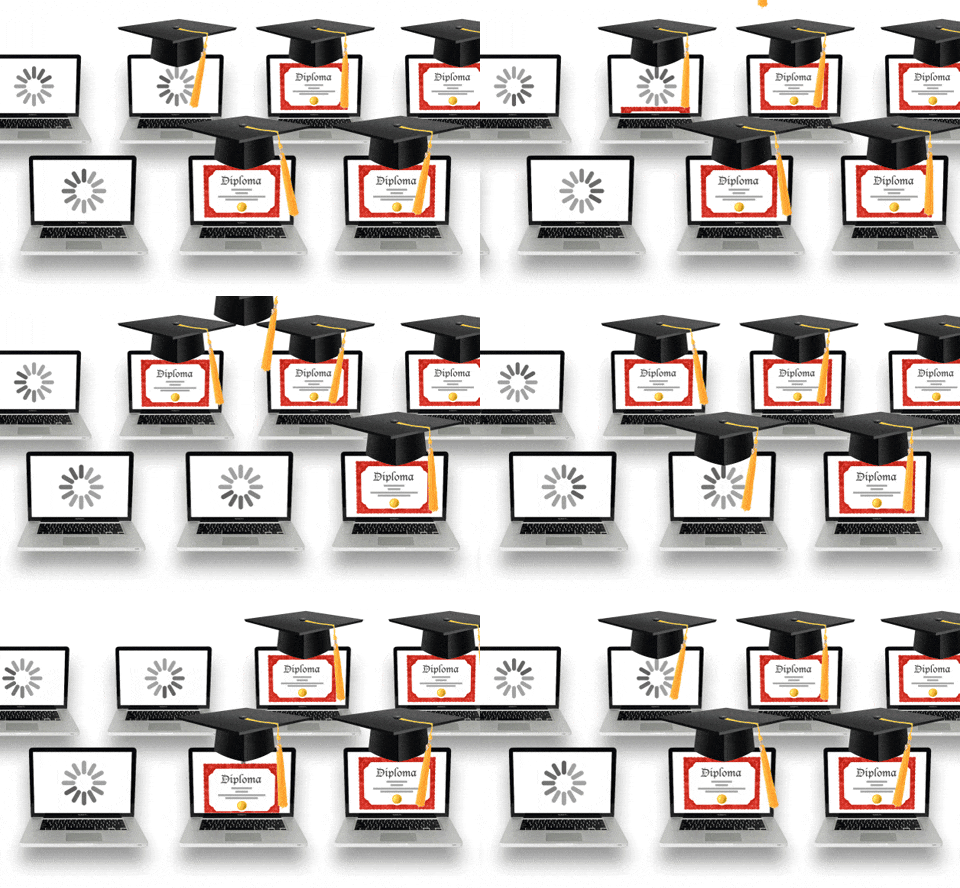

It makes me wonder!

I believe (optimistically) that affordable access to high quality higher education and education, in general, would be widened. This progressive change of being able to watch lectures/seminars of top universities from the comfort of your home is a great force for good and I hope it stays this way.

For instance, you could now learn various subjects from mathematics to quantum physics on MIT’s YouTube channel for free.

You could get a university degree through online learning without setting foot on the university’s campus and it’s cheaper too.

Or

Let’s flip the idea on its head and think in the opposite direction. What if we will have no higher education in 2050?

Instead we will have a hybrid form of apprenticeships with on the job learning, through online courses and a living wage pay from the age of 18.

The possibilities are endless.

What do you think would be the future of higher education?

Will we even have a higher education sector?

Only time will tell what might happen.


Thursday, 15 February 2018

9 reasons unconditional offers are a BAD IDEA


In the last few years, a number of institutions of various shapes, sizes and repute have been dishing out unconditional offers on the basis of predicted grades. But is this good practice? Do students benefit?

For my money, the answers are usually a resounding 'no' to both questions.
  1. Some applicants will receive an offer and think 'game over'. The foot will come off the gas and performance will slip (recent UCAS research show that those who receive unconditional offers are 23% more likely to miss their grades than those who didn't - see this chart borrowed from a 2016 UCAS research paper);

  2. Employers look at A level grades (particularly for apprenticeships, graduate schemes etc), and will disadvantage those who have slipped as a result of the above;
  3. Schools are put in a double bind of a) trying to re-engage unconditional offer holders and b) trying to mitigate against knock on effects to classmates and colleagues;
  4. Schools may also 'play the system' and encourage enrolment at more 'prestigious' institutions if, for example, they predict grades which will see applicants accept a place at (for example) Poppleton rather than Poppleton Metropolitan;

    Sorry; I think, I might be in the wrong place
  5. Students who may receive more support and fare better at Poppleton Met but who are lured to Poppleton, may end up at the 'wrong' uni and become disenfranchised and alienated from higher education altogether;

  6. Similarly, course choice may be driven, not by passion for the course or research into the uni, course content, teaching etc., as by a decision based on flattery and an HEI's reputation and/or ability to promote itself;
  7. Long term effects on many universities are likely to be damaging - "Lower tariff" institutions will lose income and "Higher tariff" will see a reduction in their league table scores after a few years of declining entry tariff points;
  8. If the logical endgame of this process is the reduction in the number of departments, courses and institutions, there will be less choice in the market;
  9. The enthusiasm for unconditionally offering to students evidently regarded as little more than three years' worth of fees (or at least one, if things do inevitably go belly up) is - to my mind - indefensible. And another sign the HE system is on a trajectory where, however much students are said to be at the centre of the system, they're not. Market is king and institutions manipulative and resourced enough to succeed will fight, claw and elbow their way to the surface.
All comments, criticism and name calling in the box below please.

Unonditionally Guaranteed.
The Captain's reviled
commercial effort. 'Nuff said.
Bedfordshire's tariff requirements are low. While this impacts on league table and other reputation measures, it demonstrates our widening participation mission. It also presents an awkward question; do we want to make unconditional offers to non-ABB students and risk helping damage applicants' A level results, denying them the chance to shop around with more points in Adjustment or Clearing and/or restrict their future career choices?

We have an alternative to unconditional offers. Our foundation year option and the 'guaranteed place' may sound similar to an unconditional, but it is different. We do not offer unconditional entry to level 4, but have a foundation offer for students who - for whatever reason - need it. This could quite conceivably include those who have been burned and underachieved after being falsely lured in by an unconditional offer in the past. If and when we get these people, great. The fear is, however, that they will already have been put off by HE altogether.


Friday, 9 February 2018

The art of 'up-skilling'

I'll be honest, I felt a little uninspired when it came to writing my blog post this week. A great deal of the team's time has been taken up with the 2019 Undergraduate Prospectus over the last few weeks, and I think we've all gone a bit crazy and cross-eyed from the proof-reading! It's not quite ready to be revealed yet, so I'll leave that for one of the team to do when it is. 

Instead I thought I'd rather talk to you about some of the new skills Sara and I have been learning thanks to our manager, David. He has previously spent time as a graphic designer, and he has a lot of creative skills that would be incredibly useful to us, so has made it his mission to 'up-skill' us over the next few months. 

Photoshop  -

Although we have a working knowledge of Photoshop, we've recently been exploring some more unique design ideas, including something called 'double exposure'. I don't take to learning slowly, so I said I'd figure it out, and off I went. On my third (!!) attempt I managed to create this...


It's still a work in progress, but I could barely re-size a picture four months ago, let alone layer two separate images over each other! We're looking forward to being able to replicate these kinds of techniques in the campaign work we do over the next few weeks, so watch this space.

Dreamweaver/Coding/HTML (whatever you want to call it) -

The other skill David has been encouraging us to learn, is how to code. We write a fair few emails, and occasionally problems arise with them that can only be fixed by going into the HTML code, and figuring out what's gone awry. Designing them works in a similar way - the software we use has limitations, and knowing how to create tables and change text formats through code comes in quite handy. It's a complicated process and I didn't think I was taking any of it on-board until last week when I 'broke' an email, went into the HTML, and fixed it. Pretty cool, huh? 

I even just went into the code of this blog post to try and figure out why the picture above isn't centered like it should be. Ironically, I can't make any sense of it! But in the words of Hannibal Smith - "Give me a minute, I'm good. Give me an hour, I'm great. Give me six months? I'm unbeatable." So check back in with me in August, okay?! 


Me coding, funnily enough. Caffeine helps. 
And there you have it, as far as the art of 'up-skilling' is going, David's doing a pretty good job. We'll be better than him in no time. But I think that might be the point. 

Until next time. Over and Out. 

Friday, 2 February 2018

Reflecting on the past and looking to the future

Next month I will be celebrating my third anniversary of working within the Marketing department at the University of Bedfordshire. Although at times it doesn’t feel like I’ve been here that long, upon reflection it’s been a busy three years! In that time there’s been a desk move, a few changes to the team, and a change in my job title, and that’s just me getting started! I’ve also worked on five prospectuses, written countless e-zines, and interviewed several of our students and staff for video content and case studies. The team have also won various awards from Heist and CIPR (shameless plug - sorry!).

Whenever people ask me what I love about my job I always answer with the diversity of the role. The great thing about working in a Marketing role is that no two days are ever the same – some days I’m writing copy for our marketing materials, other days I’m briefing our designers on our artwork. You may also find me roaming around campus taking photos and video footage, or even helping the Recruitment team at our Open Days and other recruitment events. There are of course tasks that are more regular, such as promoting our Open Days, or writing content for our monthly e-zines, but other tasks, such as organising photo-shoots, or having the opportunity to sit on tender briefings may only take place once a year. 


The other great thing about my role is that, due to the nature of the marketing industry and the higher education sector, my role is ever changing. Because of this I’m always learning , whether this be through
attending higher education forums, or through in-house training. When I started this role I had limited experience with Photoshop, and though I’m far from an expert, I’ve developed my knowledge throughout my time here. Over the next few months I will be furthering my knowledge of the Adobe package by learning how to properly use InDesign, which will help me when I’m creating various promotional materials within my role. I’m excited to develop my skills in this area and will hopefully be able to share some of my work with you soon!

Sara

Tuesday, 23 January 2018

What is it like to be an intern at University of Bedfordshire?

As an intern at the Communications department /MARC/ of the University of Bedfordshire I was given the opportunity to work alongside experienced marketing and recruitment professionals, always willing to help.

Besides developing my communication skills, I have learned about the structure of the department, how the different positions are related and the importance of organisational structure for work efficiency.

Furthermore, I have developed a better understanding of the factors that contribute to a student’s decision to choose the University of Bedfordshire over other options and how the University is meeting the students’ expectations by delivering a wide range of courses developed in conjunction with the market demands, world- class facilities, a new state-of-the-art library at Luton campus and unlimited opportunities for development. The academic lecturers across all disciplines have significant industry experience and research history. Soon, a £40m investment by the University will deliver new subject areas in STEM including Automotive Engineering, Pharmacy and Optometry.


I was given extended information about the marketing research at the department. Based on the marketing research data analyses, recommendations are produced to the academic departments, with regards what to deliver for an improved learning experience. The essence of the research work is that the information is used for decision making. I was introduced to the digital and traditional marketing practices adopted by the University.

My particular placement is at the press office of the University. This is the first point for communications with the University. From the first day I have been given real tasks. I was trained to use software for media intelligence and to create a media report. Writing content for short announcements and articles is a daily routine at the press office.

Currently, I am given a challenging task - to plan a marketing campaign for the Go Green Week. To complete the task the first thing to do was to research the sustainability policy of the University. It's really impressive what gets achieved by the University and its employees. The University of Bedfordshire currently holds the 6th position out of all other universities in the UK for delivering sustainability. To achieve this prestigious award and being classified as a first class university for sustainability, Bedfordshire has implemented significant innovations on campuses. These include green sedum roofs to harvest the rainwater and increase the biodiversity of the surrounding areas, extensive use of solar panels and a wild flower meadow project currently running at Putteridge Bury.

The University has made an excellent decision to include the Graduate Development Program into its curriculum. I'm so grateful for my time here, as well as all of the opportunities I have been given. I have developed new skills as well as enhancing my understanding of the industry I want to go. With my improved skill sets, I am excited to move forward to the next chapter of my professional journey! I cannot wait to see what doors this internship will open for me!


Teodora Todorova
Marketing Assistant Intern


Thursday, 11 January 2018

To survey, or not to survey.....

Happy new year everyone. 

Hope you got through the turkey, Baileys and mince pies (other festivities/comestibles  available) and are  plugged in to take 2018 by the horns (other animal parts also available).

January often brings hope and expectation. Or a sense of tension and gloomy foreboding. Is such optimism/pessimism well-founded? One way to find out would be to do a survey

Meh.

In this blog, I’m going to look at when it's good to use surveys, their limitations and when you may be better off doing something else. Knocking a survey together is dead easy; crafting a questionnaire that delivers is a different prospect. It's like comparing Dairylea with Stilton. And so, ok, sometimes there's time for Dairylea......... if you're a maniac with no taste (see left).


Why survey?
Good question. One you should always ask yourself and/or your survey sponsor. If you don't have a  clear set of aims and objectives, scrap the idea. If the reason for doing the survey is anything like “It would be quite interesting to…..”, turn on your heel and FLEE.

Medieval fleeing
Surveys can confirm hypotheses and quantify suppositions, but rarely provide insight. If you're after insight or new ideas or have no idea of your audience views, you should chatting to them, not surveying. Listening rather than asking questions. Unless you have a good idea of your outcomes or potential outcomes beforehand, you’re on dodgy ground setting questions and expecting meaningful answers.

How do I confirm hypotheses and quantify suppositions?
Surveys. Though bear in mind, surveys are blunt instruments. The ideal market research survey should:
  • be accessible (usually online - but do consider anyone without access to computers);
  • be as short as possible - only ask questions key to the survey aims and objectives and keep open ended (non-precoded questions) to an absolute minimum;
  • be piloted (tested). Get another set of eyes. I get fantastic help from colleagues in the CRM team, who have no problem telling me when questions or layouts don't work. I don't pretend to be Gary Gallup or Micky Mori, but would be happy to cast an eye over any survey you may be proposing - give me a shout;
  • like I said, be AS SHORT AS POSSIBLE - if you don't need to know the views of different sexes or age/ethnicity groups, don't ask (it's good practice from a GDPR point of view);
  • contain questions which are  clear and unambiguous, and easy to answer (remember, you can't explain things or correct any misinterpretations if you're not face-to-face). Here are some of the more common mistakes when drafting questions;
  • be something which can be acted on – don’t ask about a la carte dining experiences if you’re researching locations for a grotty tea bar;
  • Keep questions as short as possible
  • be something people will want to do. Offer incentives (very important for students; staff aren’t allowed a prize draw, although you could think about a charity donation based on the number of responses).
Check and share data early – an early check will confirm if an online survey is working. It may also prepare managers for any shock results if you're lucky/unlucky to get them.

Be prepared to be ignored
So. There will be times when minds are already made up. I recently carried out a survey looking at different choices of artwork. It was a good survey and gave a clear "winner". Inexplicaby, the third most popular design - there were four in all - was used. Fine. This isn’t a sob story. It does, however, illustrate how running a survey can be a waste, both in development and time spent by respondents. It’s always worth asking “will these results matter”? If not, why are you surveying?

Who do I survey?
You should be looking to represent the views and taking time to identify and reach a specific audience. This could, for example, be students, applicants or staff. It could be a combination of groups. Think about each audience's expectations – students and applicants may expect an incentive (immediate gratification), staff may be looking for feedback down the line to engender (so encouraging engagement and buy-in).

When should I survey?
Again, think about your audience and plan.

  • For most audiences avoid holiday times;
  • Check what else is going on, survey-wise. If you want to survey students, you need to contact the Student Experience team;
  • If you want views on an initiative, it's best to ask the questions after the initiative;
  • If you want to test the initiative, you may think about repeating questions before and after the initiative and check out the difference.


Anyway, this is all basic stuff. Quant 101. But then surveys should be basic.

Thanks for reading. This weekend, I'm going to have a shave and a haircut. i might think about The Ramones. Here's The Ramones with a top tune:


Tuesday, 2 January 2018

New year, same you. Just better.

Happy New Year everyone, I hope you had a great time celebrating! 

I feel there's a level of expectation about the first blog post of the year, so I hope I won't disappoint! It IS going to have a 'new year's resolution' type of message, but one I hope you won't find cliché.

I've never read a 'self-help' book in all of my life, however I asked for a book for Christmas called 'How to be a BAWSE' by Lilly Singh. What's a Bawse, I hear you ask? Well it's like a boss, but better. It's when you're not just surviving life, you're conquering it. Lilly is a YouTuber I watch (am I showing my age yet?) and her motivation and drive for business, work and life always astounds me, so I thought I'd give her book a go. 

Yada yada yada, long story short...it's amazing. It's essentially all the little arguments and discussions you have with yourself written down. With solutions. I'm a fair way through the 50 chapters, but these are two of my favourite points so far, and I hope they'll be helpful to you too.

1) Schedule time for inspiration.

I'm not entirely sure who reads this blog, but I'll go with a wide assumption that most of you are working. When you have a job - a day in, day out, 9-5, doing similar things over and over kind of job - updating and re-vamping can be the last things on your mind. Well here I am, giving you permission to schedule time for inspiration so that you can change that. 

You're a web designer? Spend 15 minutes searching for your favourite websites. What do you like about them, is there anything you could replicate within your work?  
You're an architect? Watch a TED talk on how architecture can transform urban spaces. It might give you some structural ideas you've never thought of before. Boom. Inspiration. 
Script-writer? Go on Netflix and watch a genre you're not usually interested in. The story-line or characterisation you see might help you create a play that's unique and different to anything you've ever created. And there you have it. Inspiration = motivation to do better. 
We try to do it here in the Marketing team too sometimes. Recently Pete (Digital Marketing Manager) gave a presentation on some of the best digital marketing campaigns out at the minute, and we picked our favourites and thought about how we could use some of the methods in our own marketing. I'm not sure about the others, but I left the room feeling like we could make some legitimate changes to better our work. Don't treat inspiration as an after-thought, schedule time for it. Otherwise creativity dies. 

2) Don't keep doing the same things, and expecting a different outcome.

I have to learn this lesson the hard way pretty regularly, both at work and in my personal life. Most recently, I have been working on a series of emails promoting our February course starts. We (my manager David and I) sent out a first wave in mid November and they performed pretty well. We then needed to send a reminder email out in December. We tweaked the design a little and cut down the text, but the messaging was the same. And guess what? They tanked. I looked at the reports and just thought, why am I surprised? I did the same thing but expected a different outcome. I'm aware there were also external factors at work, like timing and the fact that it was a second email, but even so. I should have known better. 

So please, write it on a post-it note and put it somewhere you can see it. Because you're not going to get fitter if you always take the escalator and not the stairs. And you're definitely not going to learn anything or find a new hobby if you don't audition for a choir, join a gym, or watch a YouTube tutorial on how to learn HTML code. (Okay that one's specific to me, but you get what I mean). 

I'm hoping that was more of a motivational speech than a boring lecture, and that it also brought you up to speed with some of the things we've been doing in the marketing team as well. 

So remember...new year, same you. Just better. 

Until next time. Over and out.